Total Pageviews

Sunday, February 10, 2013

Indonesia III

One Sunday I attend church with my hosts, at an interdenominational church service attended by many faculty and staff of Satya Wacana.  This morning the pastor, visiting preacher, and music director, who smoothly conducts the congregational singing of the liturgy as well as the choir, are all women. The congregation sings heartily, the hymns, all in Indonesian, sound heartfelt.  During the sermon, which I cannot follow, I challenge myself to notice idiosyncracies of Indonesian speech.  There is elision.  Short e is sounded as a soft 'uh,' and v's are tantamount to f.  Elders take up two separately designated offerings, in blue velvet bags hanging from double-handled wooden circles which the we pass to each other along the pew.  After the service, everybody shakes hands with everyone else, as is their custom. We pour out into the morning sunshine.  Cheerful conversations and more handshakes follow.  We go out for lunch.

In addition to the fresh air, breathtaking views, and convivial conversations, my Indonesian week includes
dining out at several local restaurants.  One day there is Kula Arum, a secluded, overgrown greenery-hidden, vintage looking building, which is actually a large, well-appointed, open-walled, marble floored pavillion made to look older than it really is.  Another day there is an nondescript looking building that turns out to be a series of dining rooms of various sizes, interspersed with dividers and copious plants, and tended to by a bumptious American woman who greets Rosie boisterously, and updates her on the whereabouts of mutual acquaintances, while a parrot in a cage near the desk keeps an eye on us all.  After a walk through the pasar on Saturday, we dine, poolside, at a fifth floor restaurant with parapets overlooking the town.  I have the most delicate beef stroganoff ever, comparable only to the lamb ragout I enjoyed a couple years ago in a New Delhi garden restaurant.  As the meal concludes, we are treated to the dramatic sight of wind sweeping a rainstorm over the mist-shrouded volcano and hills in the distance.

I can't help comparing the bazaar, called pasar in Java, to similar experiences in India.  Sellers of all kinds
of fresh produce:  fish, flowers, meat, fruit, and vegetables on the pavement or in tiny shops, other shops with crude tools, simple toys or jewellery--you name it-- line the aisles, with hardly room to walk between them and the walkway, where motorcycles move calmly and carefully along with the walkers.  The pasar seems to be as big as an American 'block,' with shops like this, often two deep, on all sides of a solid warren of tiny lanes leading to small shops of more varieties of goods....We spend an hour only walking around the outside of the pasar, thankful for a roof wide enough to lend shade as we shop. Vera quietly produces an umbrella for me when we pass a stretch under the hot noonday sun. Dani buys me a rather attractive cowbell that I admire.
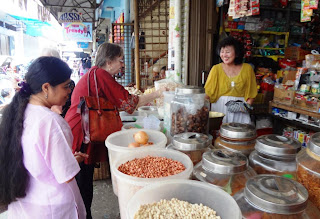
The town food inspector greets the Kameos as she comes to check out the meat stalls.  Whole and cut up chicken, red meat being sliced on a table, you name it, are all right out in the open, and looking surprisingly clean.  A plump woman meat seller exchanges pleasantries with Rosie.  Everyone seems affable, open and unselfconscious as Rosie snaps pictures along the way.  At a tin-roofed section of sweet treats, we watch, taste and buy a local version of peanut brittle being made with crude brown sugar.  Nearby a man patiently pedals a bicycle affixed to a tiny platform where a little girl enjoys the resultant back and forth of a miniature car, much like an American child would enjoy the animal or car 'ride' at a mall or supermarket.  We pick out a few bundles of fresh flowers.  My feet are complaining, but it's tempting to stay and see some more.

I'm tired but happy as we drive back to Solo for a flight back to Singapore, where I'll connect with my onward flight to India.  I wish I'd thought of allowing time for souvenir shopping at the airport, but the Indonesian puppets and basketry products I admire there will have to wait for another visit.  PTL I get
three seats to myself, and am able to stretch out and sleep on the flight of several hours


Wednesday, February 6, 2013

Expect the Unexpected, a Tuesday list of random happenings

This week's Tuesday list challenge is "Whatever you like," so I'll share a couple of random unexpected events experienced since I came to India in mid January.

One night, after the others have gone to bed, I am still on the computer.  I fail to notice a soft voice calling, "Madam..." until about the third time, when I realize the voice is at the living room window just opposite me  (there's an iron grid, but the glass window is ajar).  'Evaru?" (who?) I call.  "Chendu," the voice replies.  Not recognizing the name, I call to my husband in the next room.  "Just tell him to go away," he says.  Hm, someone just coming to visit too late, I think, and ask the voice to leave, because everyone is asleep.  Silence.  Then,  even quieter: "I love you, Madam..."  Startled, I tell him in sterner terms to leave, while sister-in-law and husband, hearing my voice raise, emerge from their respective rooms to assure me that it's just the neighbor's husband, who occasionally comes around a bit inebriated.  Not to worry.  I am annoyed. They laugh. I am not amused.

There are plenty of women's beauty salons in Guntur, with a full range of salon services.  I opt for a haircut, and climb the stairs and round the L-shaped balcony to The Little Princess Beauty Salon.  Three young women, perhaps teenagers, welcome me.  I ask for the 'Madame" (common name for woman proprietor as well as respected woman here), whom one of the girls calls on the cell phone, and Madame says she'll be right there.  The gals surround me to conduct a rather typical foreigner-interview.  What do you want (done)??.  What country are you from?  How do you know how to speak Telugu?  Where do you stay in Guntur? Do you like India?  They tell me their names, and withdraw to look and think of more questions.  One of the girls comes close and quietly asks me which church I attend, and tells me she attends the Believers' Church near the Baptist Church, that she and her sisters became Christians after their mother came to be a believer, but that their father has not...he drinks...Madame arrives and everyone busies herself, as we discuss what kind of cut I want.  "Boy Cut" seems the closest, and I describe the modified effect I would like.  Madame places the scissor near my ear as she asks how long I would like it, and before I know it, she clips it close to my head all around the ear. Alas, "Boy Cut" is what she hears, and boy cut is what I get.  Oh well, at least under what's left, it's still me.  

Franklin and I pay a visit to Ganapavaram, where we have had a PUSHPA evening school the longest, and a beaming little girl thrusts a fistful of rosy pink hibiscus blossoms into my hand.  We are shown to chairs under the open-sided building's  corrugated metal canopy, and chat with a handful of early-arriving children as more children and adults congregate after their day at field work or public school.  Other little girls get into the spirit of giving flowers, and soon I have a lapful.  As we begin our meeting a little more formally, one more child, whom I remember as a wide-eyed, chubby-cheeked baby in her father's arms when we first began, several years ago, shyly slips me one more flower...and then presses a small coin, worth perhaps two cents, into my hand.  I look at the coin and at her:  each of us apparently considering the appropriateness of the latter gift, which I hesitantly offer back to the child.  I smile, suggesting that she save it.  She does not hesitate, but takes the coin carefully back to her school bag. Did I do the right thing?  Did she?  Lord knows.  What would you have done?

I've been happy to find that we can buy pre-mixed batter for a fermented lentil crepe dish that I like, right in Minneapolis, recently.  It's only one of several common breakfast foods in India, but one that requires a bit of prep-work.  Lo and behold, the pre-mixed batter is being used here too, and we have dosais, clearly one of my favorite breakfasts, almost every day.  A pleasant surprise.

This morning I visit a tiny hospital, being developed by friends, Dr. wife and husband, to serve an inner city neighborhood, in an old mission bungalow.  Hoping to share more information about it with you, I take several photos. I ask my tour guide, the Dr.'s teen-aged daughter, to lie on a bed, pretending she is having a test.  She does, and I take my picture.  But suggesting photo participation here is like offering honey to bees; one or another chuckling staff member eagerly volunteers to lie on every bed in every department after that.  I demur at posing patients in every picture, and the group desists, dropping back to simply observe my reaction to, and suggest photographs to be taken in, the rest of the facility.  As I am leaving, a number of patients and patients' families are checking in, and the good Dr. wants me to take a picture of folks now crowding around the admissions desk.  I agree, provided that they all agree to be photographed, and Dr. has no trouble in informing them that I want to take a picture.  'Want to take one un-posed, but announcing is tantamount to posing, and I finally have to settle for taking several shots of a random group of people resolutely facing the camera.  Many are still smiling as I 'take leave.'  Most Indian people have an innate  propensity for 'presence of mind,' and are able to seize all kinds of opportunities on the spur of the moment. But allowing a photographer to take a spontaneous photograph is not one of them.  I keep hoping.

One more 'surprise' -- At our 'old' house, we used to hear the neighborhood night watchman several times during the night, the clank of his rod on the ground and soft 'twee' of his whistle reassuring us that all was well.  But this year I hear the same whistle in broad daylight, in the late afternoon.  Two saree-clad women, their hair and faces tied with a protective covering, come by, pushing a low-platform, light-weight cart equipped with several large garbage cans, and calling at homes to take out the days' garbage, which they eventually empty at a neighborhood dumpster around the corner. Discarding of trash and indiscriminate dumping continue to be problematic in the Indian environment, but these enterprising ladies, with very little investment, are making the most of the opportunity (and the increasing number of paved streets) to create a much needed business.  I salute them.

Tuesday, February 5, 2013

Indonesian Interlude, Part II

Dani and Rosie’s morning walks in Salatiga go uphill and down, sometimes at what appear to me to be forty-five degree angles, in streets around their neighbourhood of homes, retreats, small fields, all surrounded by densely green areas of trees and bushes.  After just one try, via streets Rosie kindly recommends  for wimp-walker- me, I content myself with several rounds of the driveway and the brick patio outside my guest room windows.


Two nights of rain are followed by two nights of high wind, sending occasional coconuts, papaya, not-quite-ready-to-harvest guava, and even a few palm branches thumping against the house or littering the driveway.  But each morning the sun shines anew, inspiring songbirds and highlighting flowers, particularly a large, scarlet honeysuckle-shaped blossom with eight slender petals, hanging upside down from single straggly vine in the arbor above ‘my’ patio.  One afternoon I am treated to the sight of a slender sparrow-sized bird that appears to be a hummingbird, hovering to sip from a similar bloom, just under the arbor canopy.

The town of Salatiga reminds me of India. Medium small shops lining a faded pink, colonial era looking mall are crowded with goods in indifferent condition, somewhat haphazardly arranged.  A grocery store, like an old, overcrowded country store hanging on to its existence into the fifties.  


We visit a batik shop, where cloth of batik and other varieties are compressed into shelves and pile on tables, to view which the proprietor’s assistance is required. He unfolds several heavy bolts of a certain type of cloth, to demonstrate how the cloth feels cold and damp, the significance of which I fail to grasp:  perhaps they are ‘fresh’?  Rosie tells me that if the cloth feels cold or damp to the touch, it will be cool and comfortable to wear, and that Indonesians often consider that when purchasing cloth.

I move over to the more ordinary cloth section, and purchase two designs that please me, realizing only later that one of them is ikat, a dying/weaving technique also done in the area of India I will visit next week. The proprietor treats us to a small drink box of water, a welcome treat after shopping here and there for over
an hour.  Usually husbands tire of how long women can shop, but we have to laugh when we realize we are the ones waiting for Dani, supposedly buying a light bulb, but, in fact, visiting with shopkeepers, old friends, along the way.

I ask for children’s music at a tiny roadside CD display, and two men (I’m not sure whether the second was a bystander, friend of the seller, or perhaps the owner) scrounge up a disc by an Indonesian child rock star who, they assure me, is wildly popular in Indonesia.  I hope my grandchildren, rock connoisseurs themselves, will concur.  

Traffic is similar to that in India, everything from bicycle rickshaw (driver in the rear) and motorcycle to auto and truck, but sharing the  lane-marked road quietly: no honking of horns!  Traffic signs remind one of the rules; lest anything be forgotten, there's even a sign that is simply one big exclamation point!

One day we drive to Semarang, a city an hour to the north of Salatiga, where, as  head of the Central Java Research Bureau, which reports to the governor of Java on development policies, programs and projects, Dani convenes a meeting.  The bureau's name in Indonesian, "Dewan Reset Daerah, Jawa Tengah" looks like it could be fun to pronounce.  Dani later regales us with a humorous take on getting all members of a newly formed committee 'on the same page.'

Rosie, Vera and I lunch at Ciputra  Hotel where there is a sumptuous buffet, We visit a modest shopping mall, replete with special promotions in the atrium, and a more upscale mall, not so different from an American city mall, where Dani joins us for coffee (my vote:  hot chocolate) at a Starbucks. Travel malaise is still with me, and it’s hard to stay awake on the drive home.


Friday, February 1, 2013

Morning, in India

What the heck time is it over there, anyway? a Minnesota friend texts, You seem to be on the computer around the clock!

While I admit to having spent mid-night moments on the computer, the confusing truth is that time in India is eleven and a half (yup, a half, go figure…) hours ahead of that in Minnesota.  While Rita is going out on an errand before supper, I have just gotten up at the usual time of six o’clock in the morning.  The sky lightens, but the day starts with a thin gray fog of mist cum air pollution that burns away in the sun

Residents of neighborhood apartment buildings go out to work, their movements marked by an elevator call of three clear xylophone-like tones, weirdly reminiscent of the old NBC trademark sound, but with the first two tones reversed..  The couple next door have abandoned their morning and evening shouting matches in favor of slammed doors.  The only daily street vendor is the leafy greens seller, the call enumerating his wares resounding from stone buildings and compound walls as he passes by on his bicycle, a bundle of his wares tied in a damp cloth behind him:  "Aaaak-kuraluuu, thota kura, batsa kura, go-o-n-go-o-rruh'!!" On occasional days, we might hear the long-handled-cobweb-duster seller, hollering 'Boos Karra, Boos Karra!", or the salt seller,with his "Oop-POO, Oop-Poo!"

I remove the corner-ties from the four wooden sticks suspending the mosquito netting, reinforced and formed by a grid of cloth tape into an “inverted box” over our bed by night, and fold it into a dusty, lumpy ‘pillow’ at the foot of the bed. Plump up the pillows, straighten the coverlet, and lie on the futon-firm bed for my daily dose of yoga postures.  (I’m no pro, and draw the line at lying on the floor, from which I cannot rise without help.)  Then I pull aside the window curtains and turn on the fan to clear out the stale night air.
Brotherinlaw has already busied himself in the kitchen, putting away air-dried dishes.  Sisterinlaw comes downstairs and  makes a cup of Indian tea for everyone except me.  (An occasional cup will do, thank you.)  We take turns scanning the news in two differently-slanted English language newspapers and sharing bits of it with each other, while an Indian nightingale churns out a hearty throb, reminding us that there is beauty in addition to necessity…
Don tennis shoes for a walk, in the cobbled rock driveway and stone path around the house, around the neighbourhood, or, if the driver comes early enough, around the red beaten earth municipal track several blocks away.  At the track, depending on the hour, there may be equal numbers of women and men, or mostly men, of the neighbourhood and city, walking singly or in pairs, silent or chatting, wearing comfortable versions of Indian or western clothing, with flip flops, sandals or tennis shoes, earnestly putting in their daily rounds before going off (or home) to work.  Contingents of middle aged and older men sit, chatting and/or passively eyeing the walkers, from benches in one corner, women in another, and grannies and mothers on tiered seating, encouraging children learning to rollerskate on a concrete rink next to the outdoor basketball court which, with an open field and two storied gym cum community center.
Then it’s home for a quick bath (a hot one if we’ve remembered to turn on the geezer (hot water heater) for just five minutes) and a hot breakfast served up by our sister-in-law.  This year it’s possible to buy ready-made batter for a traditional breakfast dosai (soft or crisp crepe of fermented lentils), which we eat, with or without condiment, egg, or potato curry, most every day.  (Previously, one had to soak black lentils and rice overnight, and grind them into a thin batter, in a noisy, powerful blender.) Dosais are fried on a very hot  griddle, surface cooled with a sudden dash or a swipe of cold water just before frying.  Batter too thick, the dosai will lump up, and cook to a breadier texture.  Too thin, and it will spatter. Just right and there you have it, delicately brown on one side, sometimes crisp, and white on the other.
As with chappatis, rotis, and uttapams, dosais are eaten with the right hand, deftly tearing off a piece at a time, scooping up and wrapping a morsel of curry of patchadi (spicy relish) to pop into your mouth.   Eat a piece of fresh fruit after every meal:  papaya, banana, and seasonal ‘loose jackets’ (think large, delicately flavoured tangerines with, of course, loose peels) are available every day, besides guava, or an occasional thick peeled, sweet grapefruit, fallen from a tree near the house.
To be sure, I could go on all day about just the morning routine, but enough for today...It's noon, and I have yet to finish telling you about Indonesia.

Thursday, January 31, 2013

Collections: A Tuesday List

Thoughts, both bidden and un-
slips and sheets of paper with jots of things I intend to write
sermon notes, songs that moved me
commemorative postage stamps
phone numbers
letters, affirmative cards and momentoes from friends
varieties of art
paper in striking colors
piano music
mom's 40's tapes
mending projects
children's books
lists of library books, both read and intending to read
recipes I'm just going to try
mail to answer tomorrow
handy rubber bands
nifty bags
family photos
memorable verses
gifts, 'just in case'
greeting cards, both blank and all-occasion
notes of things intending to write
trip journals
lists

Hope, a haiku

Improvisation
on a bamboo flute, breathes
new life into ancient forms.

Monday, January 28, 2013

Indonesian Interlude I

Silk Air, Singapore Airlines' regional carrier, though smaller, proves just as pleasant.  The flight is full, and efficiently loaded in a  minimum of time.  Slim stewardesses, in simple, sculpted dresses of light, lime green, move gracefully among the passengers, black haired lilies on lithe stems. Every one of them is totally focused, graciously greeting passengers, securing luggage compartments, checking seat belts, and serving soft drinks as soon as the passengers are in place. One of them mimes the brief safety talk shown on tv screens above the seats. That awkward Asian game show where contestants attempt impossible obstacle courses before falling into a water tank is followed by a candid camera type show, accompanied by hot towels, and a full meal featuring fish or chicken.  The pilot points out the landscape below as we draw within sight of the Indonesian archipelago.  Frankly, our pilot is arguably the clearest, most cordial and articulate ever as he welcomes and informs us of flight time and distance, brief turbulence and views along our way. His landing, too, is whisper soft.

Solo Airport is immaculate and well attended. We are ushered via a short hallway and escalator to ground level where I pay $25 (in crisp new bills, as my hostess has advised) for a short visit/transit visa before exiting to the luggage area, where a porter finds my checked bag, and another attendant conveys the bags and me the short way to the portico where my hosts are waiting and waving.


Rosie, a St. Olaf grad and one of us "I-3's" recruited by the LCA to teach English for three years in India in the 60's, continued on with the ELCA as a university lecturer and librarian, and settled here with her Indonesian husband, Dani.  We've met seldom, over the years, but keep up a fast correspondence comparing notes on family life and  our shared interest in words and writing, so the renewal of friendship, laughter, and conversation flow freely. We drive the hour-plus from Solo to their home in Salatiga, which Dani says is in the geographical center of Indonesia as well as the island of Java.  Small businesses line the road the whole way, but I can see the landscape beyond the road is green and lush. 


From Salatiga, Mount Merapu, the most active volcano in the archipelago, looks soft, shrouded in mist much of the time, in the distance.
  
The family home is atop a hill among other hills, with a view of the town and mountains all around.  
Fruit and flowering trees almost hide the house, with a large portico and generous porch at the entrance.  


Much of the downstairs is a square of spacious rooms surrounding an atrium filled with trees and greens ranging from palm and Norway Pine to elephant ear plants and money plant vines, and a koi pond into which three jets splash water day and night. More plants in large pots surround screen doors to adjacent rooms, along with waist high, clay folk figures in welcoming postures, flanking the sliding, dining room door, and comfortable seating and a magazine table in one corner. I suspect the sound of splashing so close at hand might keep me awake at night, but it's hardly audible when I close the teak wood bedroom door.


It starts to rain as we arrive, and the rain develops into a downpour lasting most of the night, leaving every-thing even lusher and greener than the day before.  I sleep frequently and deeply, which, Rosie reminds me, is what she expects me to do after my days and the time-change of travelling.  I am surprised to find that their diet is not necessarily spicy.  We have rice and vegetables, tasty but not 'hot', every day.    A diminutive cook, Mbak Mina, pays close attention to my eating, and makes me chicken soup and gruel to counteract a cold and traveller's tummy.

We are joined for meals and forays into town by Dani's sister, Vera, pronounced Fairah, who has lived with them since 1981. She helps them to host  frequent visitors and relatives who drop in or come to stay with more or less notice, and is a person whose presence I am tempted to envy, because of the time she frees for Rosie to write.  (Rosie published her first book, LIGHT FOR THE JOURNEY, reflecting and inviting discussion on intercultural experiences, last year.)  Everyone I meet seems to enjoy an easy camaraderie, as do other Indonesians we meet on a walk through a local bazaar...but more about the Indonesia in the next blog....

These and all the Indonesia pictures are courtesy of R. and D. Kameo...manga tak, from me!